Service modeling forms the foundation of AIOps by mapping services and their dependencies. It visualizes how applications, infrastructure, and users interact, giving teams context to assess impact quickly
Learn more about service modeling vs. dependency mapping
Let us know how we can help
Sales & Pricing
Speak to a rep about your business needs

Help & Support
See our product support options
General inquiries and locations
Contact us
From manual to AI-powered ITOM (and beyond)
Operations have evolved from manual monitoring to AI-powered (and even semi-autonomous approaches). Each progressive step gives teams greater visibility, faster response, and the ability to prevent issues before they impact services.
Traditional ITOM

AIOps-powered ITOM
Semi-autonomous ITOM
Traditional ITOM
AIOps-powered ITOM
Semi-autonomous ITOM
Assembling the pieces of AIOps
AIOps consists of interconnected components that detect, analyze, and fix issues. This section shows how each piece fits into the overall framework.
Service modeling
Knowledge graph
Data quality
Capacity optimization
AI SRE
AI governance
The business benefits of AIOps in IT operations
AIOps delivers notable operational improvements for the systems your business depends on every day.
Outages are intercepted before they reach users
AI analyzes streams of telemetry and event data to spot anomalies before thresholds are met. Early signals trigger alerts or actions that neutralize issues impacting customer-facing services.

Business-critical system failures are foiled
Event correlation pinpoints symptoms back to their true root cause. Teams can then act quickly (or let the automation handle predictable fixes) before problems spread.
Teams experience less burnout and firefighting
AIOps absorbs repetitive triage work. Engineers regain hours each day to focus on optimization, improvements, and strategic planning instead of constant crisis response.

Blind spots disappear, thanks to data consolidation
Telemetry, logs, metrics, topology, and service context are unified into a single operational view. With clearer root causes and dependencies, leaders can make faster, more confident decisions.

Costly failures and compliance risks are minimized
Automated checks detect unusual patterns, policy deviations, or configuration drift as they occur. Real-time visibility and audit-ready data reduce the chance of outages, misconfigurations, or violations that can escalate into expensive incidents.

AI operations self-adapt, heal, and improve
Machine learning (ML) models improve as they process more operational data. Over time, the system becomes more accurate, more proactive, and better aligned to the environment it supports.
Optimize the performance, cost, and security of the apps and services you deliver
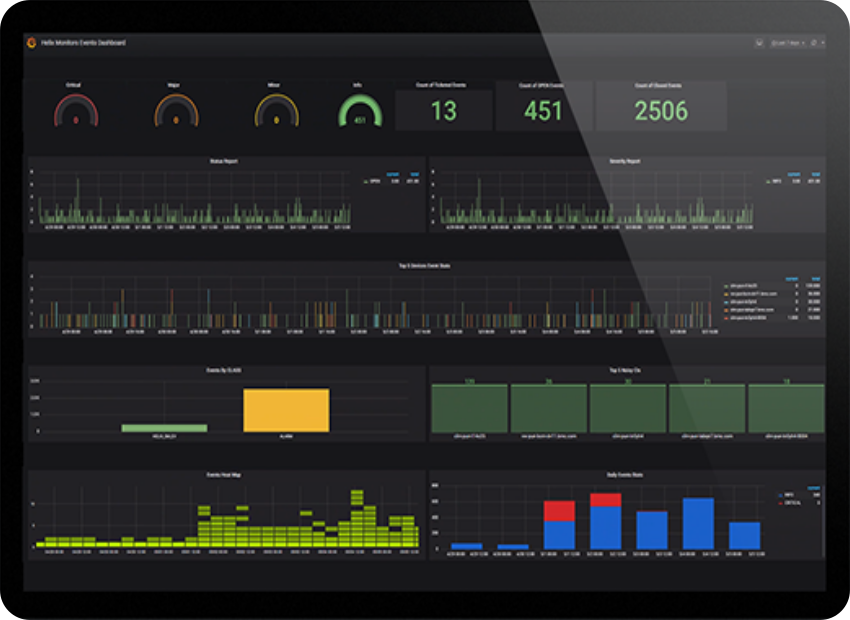
Priority AIOps use cases for scaling, stability, and speed
What are the main AIOps use cases for ITOps teams? Let’s discuss what’s possible today.
Predictive incident management
Proactive capacity forecasting
Continuous operational optimization
Intelligent noise reduction
Accelerated root cause analysis (RCA)
Enhanced decision support
Predictive incident management
Proactive capacity forecasting
Continuous operational optimization
Intelligent noise reduction
Accelerated root cause analysis (RCA)
Enhanced decision support
The mechanics of closed-loop ServiceOps
ServiceOps becomes more reliable and efficient when data, intelligence, and action are tightly integrated.
Observability captures the signals
AIOps folds intelligence into data
Automation offers action
Observability captures the signals
AIOps folds intelligence into data
Automation offers action
Achieve self-healing, reliable IT operations across multi-cloud, mainframe, and edge environments.
Explore related resources

White Paper
BMC Helix AI Agents
See how agentic AI operates as a system across ServiceOps, from orchestration to execution.

White Paper
ServiceOps: Reset the Limits of IT to Deliver Unwavering Reliability and New Possibilities
Learn how to unify IT service management and operations and harness agentic AI to shift from firefighting to innovation.

White Paper
Reset the Limits of IT with Agentic AI and AgentOps
Learn how ServiceOps and AgentOps help IT shift from reactive firefighting to governed digital capacity.