Let us know how we can help
Sales & Pricing
Speak to a rep about your business needs

Help & Support
See our product support options
General inquiries and locations
Contact us
From Complexity to Control with
Agentic AI
New Omdia research shows how enterprises are moving beyond copilots to more autonomous, outcome-driven AI.

Overview
Enterprise IT operations (ITOps) teams have discovered that traditional approaches are no match for rising complexity, escalating costs, the rapid advancement of AI, and the scale and speed required to support highly interconnected, constantly changing modern environments.
Many organizations have moved beyond AI experimentation toward more practical, outcome-driven implementations. To better understand this shift, Omdia surveyed 385 IT and data professionals across North America, examining priorities, adoption patterns, and the real-world impact of AI on ITOps.
The findings reveal that enterprises are not just adopting AI—they are rethinking how IT operates. This requires more than new tools. It requires a new operational model where AI can act with context, coordination, and control. Here are just a few of the insights from the full report.
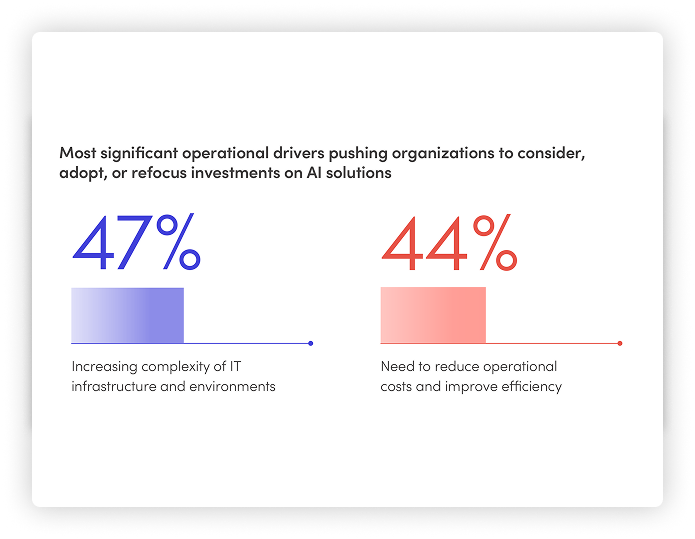
Complexity and cost efficiency
Omdia research shows the biggest operational drivers for adopting AIOps are navigating complex infrastructures, reducing operational costs, and improving efficiency.
Agentic AI helps reset the economics of enterprise IT by becoming the necessary new operating model that adds digital capacity, decreases manual effort, and helps teams operate more efficiently at scale.

Autonomy with guardrails
The report shows that enterprises are moving beyond AI “copilot” helpers toward meaningful adoption of agentic AI for autonomous ITOps—but with guardrails. Many organizations report high levels of autonomy today and expect more automation in the next two years, but full autonomy will remain the exception, not the rule.
Omdia advises organizations that want to keep pace with competitors and capture the full value of agentic AI to advance their capabilities up to levels 3 and 4 (conditional autonomy and high autonomy with oversight).
The use of practical, governed AI agents supports this vision, keeping humans in the loop as agents are empowered to take action across operations.
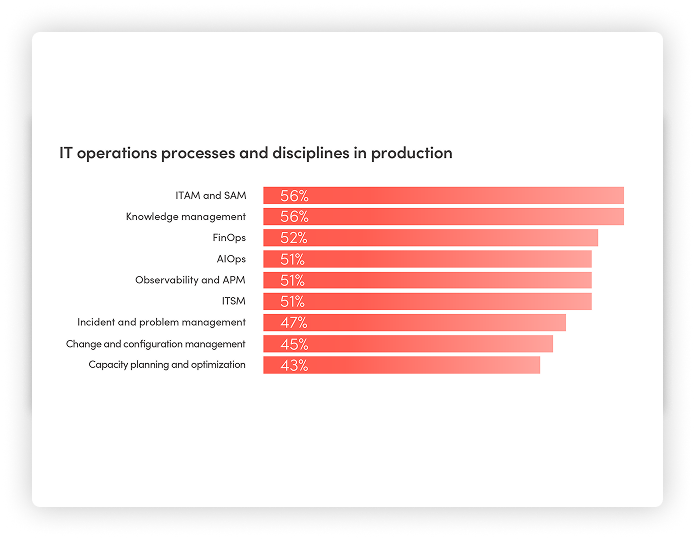
Cross-domain orchestration
Cross-domain orchestration is essential to making AIOps work because ITOps spans several specialties beyond just AIOps, including incident, problem, change, configuration, knowledge, and IT asset management, as well as financial operations (FinOps) and capacity planning.
The real value comes from connecting workflows and data across these areas, instead of deploying disconnected AI point solutions. Omdia’s findings agree that most organizations are applying AI across multiple domains, not in isolation.
This is the foundation of a ServiceOps approach, where service management and operations work together to provide the context and coordination needed for AI to deliver meaningful results.
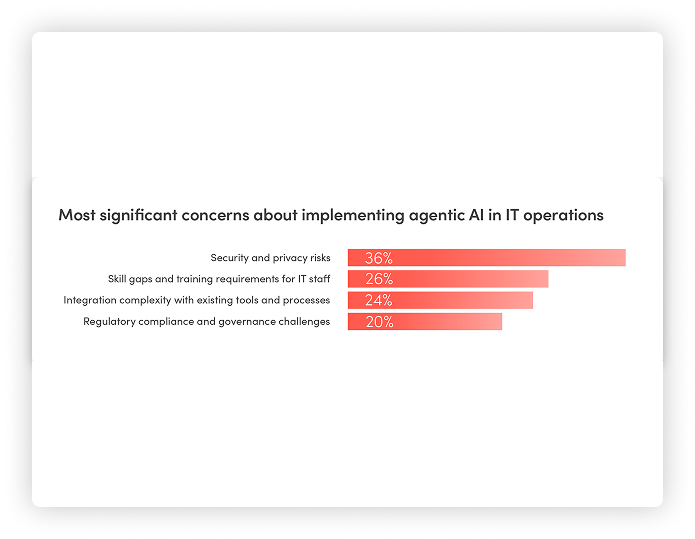
Security, privacy, governance, and compliance
When it comes to agentic AI adoption, Omdia respondents are most concerned about security and privacy risk; data privacy/governance requirements; and regulatory/compliance mandates. These concerns are heavily influenced by industry factors like cybersecurity threats, tech standards and integration, and skill gaps for AI/ML.
These concerns highlight the importance of including AI/ML skills development in any AI planning, and deploying trusted agentic AI solutions with built-in governance protocols, especially in regulated industries.
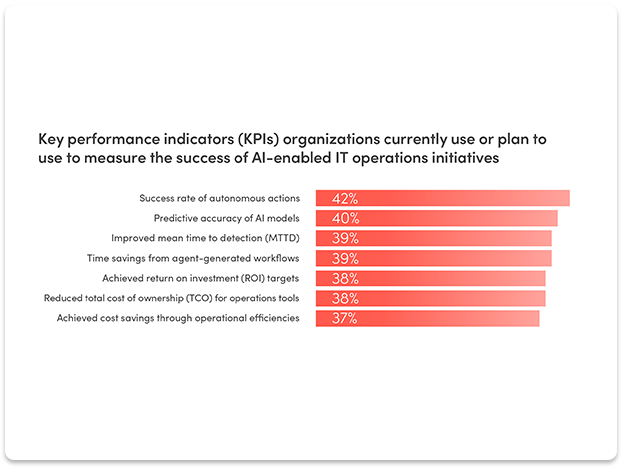
Measurable outcomes
Significant IT investments are often accompanied by a C-suite demand that their outcomes be measured and proven. Omdia found that the organizations with the most successful outcomes have a more advanced level of AI adoption.
They’re measuring the success of AIOps investments with functional metrics like autonomous actions, predictive accuracy, and time and cost savings, as well as traditional indicators like mean time to detect (MTTD), return on investment (ROI), and total cost of ownership (TCO) benchmarks.
AI has crossed the line from experiment to everyday investment—one that delivers a measurable impact the CFO can see.
Dive Deeper
Explore related resources
White Paper
BMC Helix AI Agents
See how agentic AI operates as a system across ServiceOps, from orchestration to execution.
Article/Blog
Reset the Economics of IT with Agentic AI
Learn how agentic AI can accelerate workforce productivity, reduce non-headcount IT spend, and help you manage the economics of your transformation companywide.
Solution Brief
BMC Helix Employee Navigator
Lower support costs and elevate your employee experience with intelligent, always-on guidance.
Solution Brief
BMC Helix Ops Swarmer
Accelerate incident resolution and scale response capabilities with AI/human collaboration.
Secure your business with AI governance that works
Drive efficiency and innovation safely with transparency and accountability.
White Paper
AI-powered efficiency with data compliance and security
Boost AI-driven efficiency while keeping sensitive data under your control with HelixGPT’s open, bring-your-own-LLM approach and built-in security, residency, and compliance guardrails.